
The Myodural Bridge: A Possible Link Between Upper Neck Pain and Cervicogenic Headaches
Understanding the Anatomy, Clinical Significance, and Role of Physiotherapy | by Dr.Tanvi Agarwal PT
Neck pain is commonly associated with poor posture, muscle tightness, cervical disc problems, or dysfunction of the small joints in the spine. However, another anatomical structure may contribute to our understanding of certain upper-neck conditions: the myodural bridge.
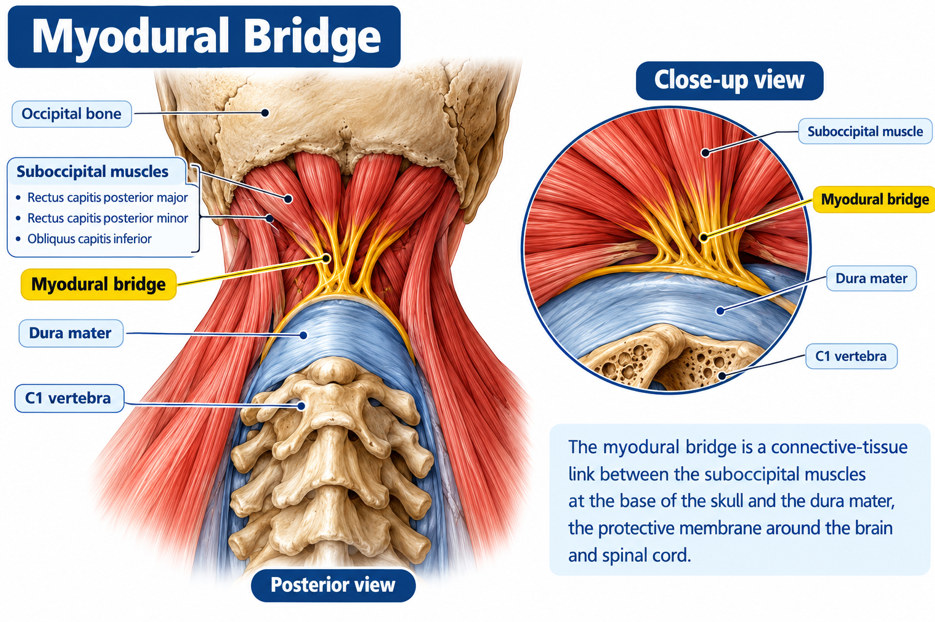
This small connective-tissue connection links specific muscles at the base of the skull with the dura mater, the protective membrane surrounding the brain and spinal cord. Researchers have investigated how this connection may influence the relationship between upper cervical muscle activity, dural movement, and neck-related symptoms.
The myodural bridge connects muscles at the base of the skull with the dura, the protective membrane around the brain and spinal cord. This connection may help explain how tension in the upper neck could influence movement and sensation in the area.
Anatomical studies have identified connections between the rectus capitis posterior minor muscle and the spinal dura mater. Other suboccipital muscles, including the rectus capitis posterior major and obliquus capitis inferior, have also been investigated for their dural connections.
These anatomical relationships have attracted scientific interest because they suggest that the muscles and connective tissues surrounding the upper cervical spine may interact with structures inside the spinal canal.
How Might the Myodural Bridge Relate to Neck Pain?
Researchers have proposed several possible functions for the myodural bridge.
1. Influence on dural movement
The myodural bridge may help transmit mechanical forces between the suboccipital muscles and the dura mater during head and neck movements. Its precise functional contribution in living humans remains an area of ongoing research.
2. Relationship with upper cervical muscle tension
Increased activity, reduced flexibility, or altered coordination of the small muscles beneath the skull may be associated with upper-neck discomfort. Researchers are investigating whether mechanical interactions involving the myodural bridge contribute to these symptoms.
3. Possible association with cervicogenic headaches
Cervicogenic headaches originate from a cervical spine disorder and may cause pain that travels from the neck toward the back or side of the head. Because the upper cervical region contains closely connected muscles, joints, nerves, and connective tissues, the myodural bridge has been proposed as one possible contributor to this complex relationship.
However, the presence of an anatomical connection does not establish that it causes headaches or that treating it directly will relieve symptoms.
Clinical Significance in Physiotherapy
Understanding the myodural bridge may encourage physiotherapists to consider the broader anatomical and functional relationships of the upper cervical region rather than focusing exclusively on the site of pain.
For individuals presenting with upper-neck discomfort or suspected cervicogenic headaches, a comprehensive assessment may include:
-
Suboccipital muscle assessment: Evaluating muscle tenderness, tone, and coordination.
-
Cervical mobility: Assessing neck range of motion and movement-related symptoms.
-
Postural and movement analysis: Identifying relevant movement patterns and sustained positions that may aggravate symptoms.
-
Cervical proprioception: Assessing the person's ability to sense head and neck position, when clinically indicated.
-
Headache assessment: Examining symptom patterns and considering other possible causes of headache.
Assessment findings should guide treatment rather than assuming that the myodural bridge is responsible for the patient's symptoms.
Physiotherapy Approaches
Depending on the clinical presentation, a physiotherapist may consider a combination of evidence-informed interventions.
Gentle soft-tissue techniques: Carefully selected techniques may help manage muscle tenderness and improve comfort.
Cervical mobility exercises: Controlled movements may help improve comfortable neck movement and functional mobility.
Deep neck-muscle training: Appropriate exercises can improve cervical muscle control and endurance.
Postural and movement education: Advice on varying positions, workstation setup, and movement habits may help reduce aggravating factors.
Sensorimotor exercises: When an assessment identifies impaired neck-position awareness, targeted exercises may help address this problem.
Treatment should be individualized, and no specific technique should be presented as a proven method of releasing or correcting the myodural bridge.
What Does the Research Tell Us?
The myodural bridge is an established anatomical finding, but its exact clinical significance remains under investigation. Anatomical research supports the existence of connective-tissue links between suboccipital muscles and the dura mater. However, further high-quality clinical research is needed to determine how much these connections contribute to neck pain, cervicogenic headaches, or other symptoms.
It is therefore important to distinguish between anatomical evidence, proposed mechanisms, and proven clinical outcomes.
The myodural bridge should not be considered a single or established cause of neck pain. Symptoms may arise from several interacting factors, and clinical decisions should be based on a thorough assessment of the individual.
Conclusion
The myodural bridge offers an interesting perspective on the relationship between the muscles at the base of the skull and the protective membranes surrounding the central nervous system. Its anatomy may help researchers better understand the complex biomechanics of the upper cervical region.
For physiotherapists, this topic reinforces the importance of a comprehensive, patient-centred approach that considers cervical mobility, muscle function, sensorimotor control, and the possible causes of headache.
The key clinical message: Understanding the myodural bridge may broaden our anatomical perspective, but effective physiotherapy should remain guided by clinical findings and current evidence—not by assumptions about a single structure.
Educational disclaimer: This article is intended for healthcare education and does not replace an individualized clinical assessment or medical advice.
Author Dr.Tanvi Agarwal PT
Admin
Content creator and administrator. Sharing insights and knowledge to help you stay informed.