Precursors to the ACL Injury
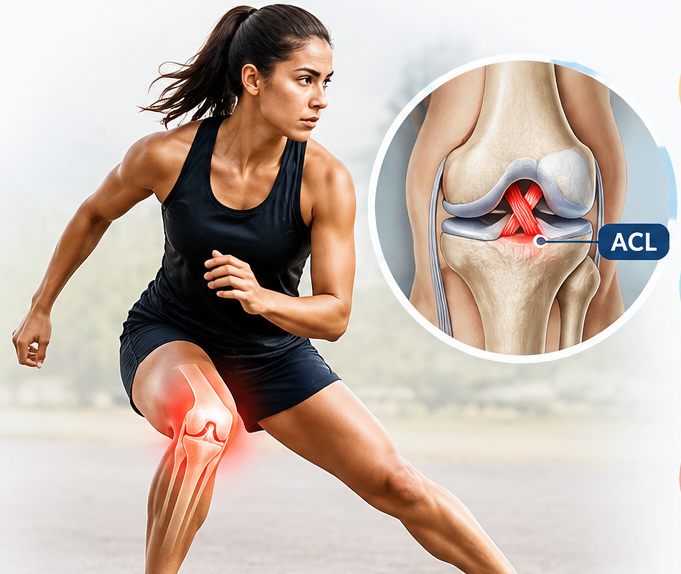
An ACL injury doesn’t necessarily begin on the day it occurs. In many cases, it may result from a combination of biomechanical, muscular, and anatomical factors that increase stress on the ligament over time. Let’s briefly understand the key precursors to an ACL injury.
1. Athletic Maneuvers
Sports such as football, kabaddi, and cricket involve rapid changes of direction, sudden deceleration, pivoting, jumping, and landing. These movements can expose the knee joint to high forces, particularly when combined with poor landing mechanics or inadequate neuromuscular control, increasing the risk of ACL injury.
2. Muscular Imbalances
Quadriceps strength is essential for knee function and stability. However, adequate eccentric control of the posterior chain muscles, particularly the hamstrings and gluteal muscles, is equally important. Deficits in strength, coordination, or neuromuscular control may contribute to increased loading on the ACL during dynamic athletic movements.
3. Anatomical Factors
Certain anatomical characteristics may influence an individual's susceptibility to ACL injury. These include a narrow femoral notch, a steep posterior tibial slope, and variations in lower-limb alignment, including the Q-angle. The orientation and structural characteristics of the ACL may also influence its loading during movement.
The Final Pathway to Injury
These factors can interact with fatigue, movement patterns, and external forces to increase the mechanical load on the ACL. When the forces acting on the ligament exceed its load-bearing capacity, collagen fibres may fail, resulting in a partial or complete tear.
Altered mechanotransduction—the process through which cells sense and respond to mechanical forces—may also influence ligament adaptation and tissue health. However, ACL injuries are multifactorial, and no single mechanism explains every injury.
Understanding these precursors is essential for developing effective injury-prevention strategies that incorporate strength training, neuromuscular conditioning, landing mechanics, and movement-control exercises.
Dr. Anush Shukla (PT), COMT, CCT
Founder, Fit2Go! Sports Rehab
Presenter, IHFA UK
Admin
Content creator and administrator. Sharing insights and knowledge to help you stay informed.